Skip to content

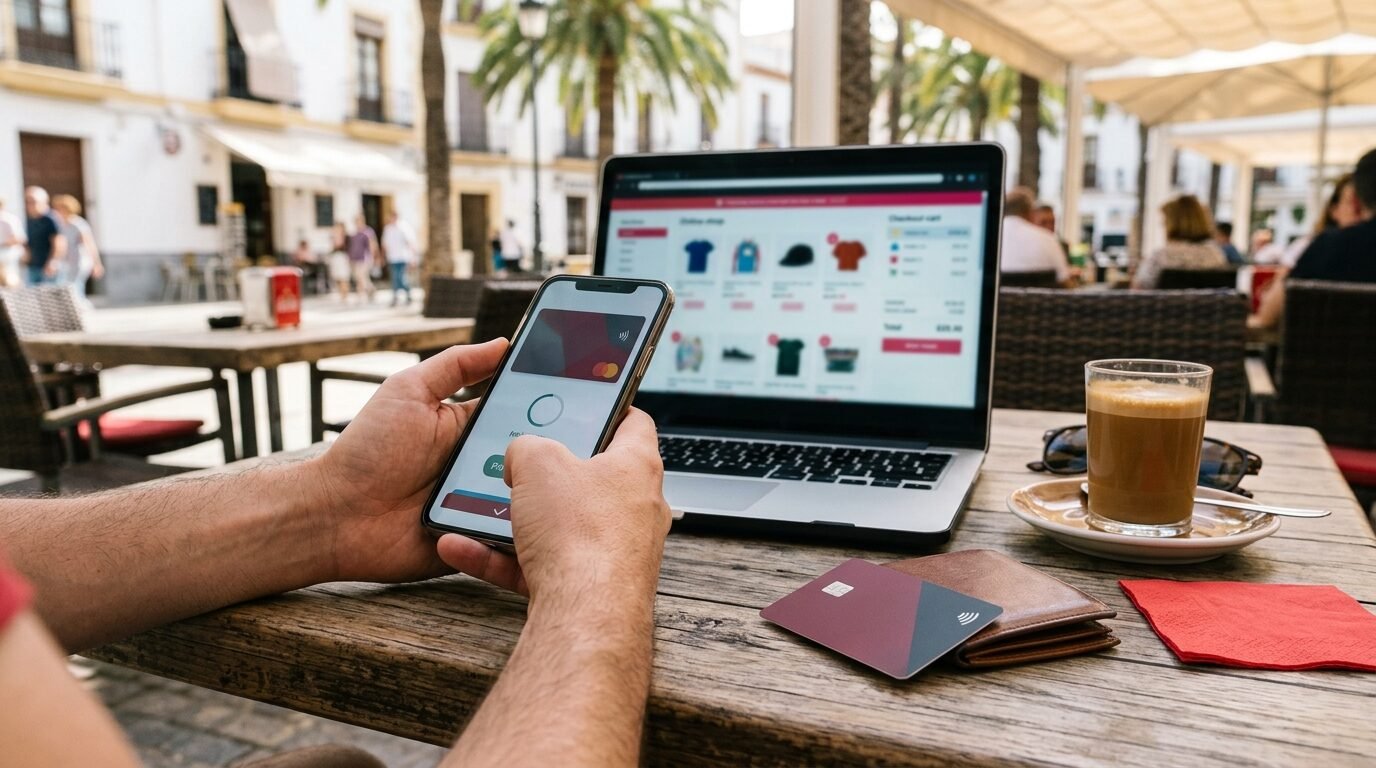
Your payment gateway is the last step between a visitor and a sale.
If it is slow, confusing or missing the customer’s favourite way to pay, they leave.
If it is too expensive, it quietly eats your margin on every order.
In this guide we go through the most common payment gateways for websites and webshops in Spain and the rest of Europe, what they cost, and how to choose the right mix for your business.
What does a payment gateway actually do?
A payment gateway is the service that takes the customer’s payment details, checks them with the bank or card network, and moves the money to your account.
For the customer it is the checkout page or the pop-up where they type their card number, approve a payment in their banking app or log in to PayPal.
For you it is the account where you see payments, refunds and payouts.
A good gateway does four things well.
It accepts the payment methods your customers actually use.
It keeps fraud and chargebacks low.
It handles security rules such as PCI DSS and Strong Customer Authentication (SCA) for you.
And it pays out quickly at a fee you can live with.
Why the choice matters more than most people think
Many business owners pick the first gateway their website platform suggests and never look at it again.
That is understandable, but it can be expensive.
A difference of one percentage point on fees sounds small.
On a shop that sells €200,000 a year, it is €2,000 every year, straight off your profit.
The payment methods you offer also affect your conversion rate.
A Spanish customer may prefer Bizum, a Dutch customer iDEAL, a German customer PayPal or invoice, and a Danish customer MobilePay.
If the method they trust is missing, some of them will simply not buy.

The most common payment gateways in Spain and Europe
Stripe
Stripe is one of the most popular choices for websites and webshops in Europe.
It works with WooCommerce, Shopify (as a third-party provider in some setups), booking systems, membership plugins and most modern platforms.
For a business in the European Economic Area, the standard fee for European cards is 1.5% + €0.25 per successful payment.
Cards from outside the EEA cost an extra 1.1%, and currency conversion adds another 1%.
The strengths of Stripe are a clean checkout, Apple Pay and Google Pay out of the box, support for many local methods, subscriptions, and a very good dashboard.
The weak points are that support can feel distant for small businesses, and that accounts are sometimes reviewed or paused if your sales pattern changes suddenly.
PayPal
PayPal is still one of the most trusted names among online shoppers, especially older customers and buyers from other countries.
Many people feel safer paying with PayPal on a shop they have never used before.
In Spain, PayPal’s standard fee for commercial transactions is 2.90% + €0.35 per payment.
Payments from customers in the EEA have no extra international fee, while payments from the UK cost an extra 1.29% and from the rest of the world an extra 1.99%.
PayPal is easy to add to almost any website and is a strong second option next to cards.
It is rarely the cheapest choice as your only gateway, and disputes are handled under PayPal’s own rules, which some sellers find frustrating.
For card payments through PayPal’s advanced card processing, the price is based on interchange plus a fixed margin, which can be cheaper for larger shops.
Redsys and your Spanish bank (TPV virtual)
Redsys is the payment network behind most Spanish banks’ online payment terminals, often called a TPV virtual.
You sign a contract with your bank, and the bank gives you access to Redsys.
There are good plugins for WooCommerce and other platforms.
The big advantage is that the fees are negotiated with your bank and can be low for Spanish cards, especially if you already have a good relationship with the bank.
Redsys is also the usual way to offer Bizum in a webshop.
The downsides are more paperwork, a less modern checkout, and in some cases monthly fees or minimum volumes.
Always ask the bank for the full price list, including fees for refunds, foreign cards and the monthly terminal fee.
Bizum
Bizum is the Spanish mobile payment system that almost everyone with a Spanish bank account has in their banking app.
For many Spanish customers it is the fastest and most trusted way to pay small and medium amounts.
In a webshop, Bizum is usually added through Redsys and your bank, or through a payment provider that supports it.
If most of your customers are in Spain, Bizum is well worth having next to cards.
Shopify Payments
If your shop runs on Shopify, Shopify Payments is the built-in gateway.
It is the simplest option, because everything is managed in one place and you avoid Shopify’s extra transaction fee for third-party gateways.
The card rate depends on your Shopify plan, and the higher plans have lower rates.
If you use another gateway instead, Shopify charges an extra fee on each order on top of what the gateway charges, which is why most Shopify shops stay with Shopify Payments.
WooPayments
WooPayments is the payment solution made by the team behind WooCommerce.
It is built into the WooCommerce dashboard, supports cards, Apple Pay and Google Pay, and is easy to set up.
It is a good choice if you want everything inside WordPress and do not want to manage a separate Stripe account.
Compare the current rates with Stripe before you decide, because they are often close and the difference comes down to features and support.
Mollie, Adyen and other European providers
Mollie is popular with small and medium shops in the Benelux and Germany, and supports a long list of local methods such as iDEAL, Bancontact, Klarna and SEPA bank transfers.
Adyen is used by large international brands and is mainly interesting when you have high volumes and need advanced routing and reporting.
For most small Spanish businesses, Stripe or a bank solution will be enough, but these providers are worth a look if you sell a lot to other European countries.
Buy now, pay later: Klarna and similar
Klarna and similar services let customers split a payment or pay later.
They can increase the average order value for products in the €100 to €1,500 range, such as furniture, electronics and fashion.
The fee for the shop is higher than for normal card payments, so it makes most sense when it really lifts sales.
Many gateways, including Stripe and Mollie, can add Klarna without a separate contract.
One solution for online and in-store payments
Many businesses sell both online and in person.
A shop, a café, a market stall or a pop-up at an event needs a card terminal as well as a webshop.
The best solution is one where online and in-store payments end up in the same overview, so you always know what you have sold.
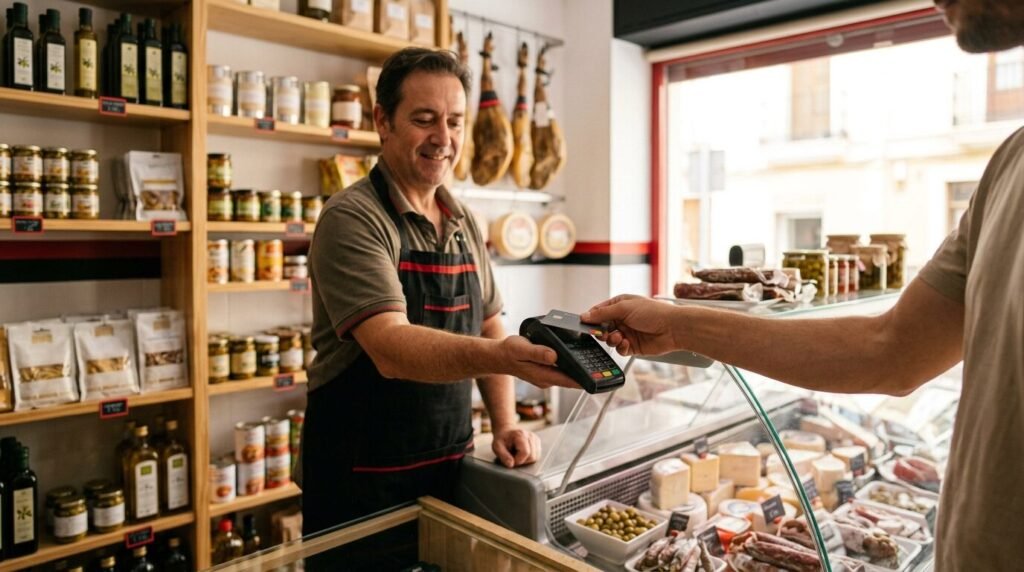
Shopify and Square offer their own POS systems for this.
Another popular option in Europe is myPOS, which we use in our own shops.
You buy the terminal once instead of renting it, there is no monthly contract, and the money from card payments lands in your myPOS account almost straight away.
The terminals accept cards, Apple Pay and Google Pay, and many models can print receipts and work with a SIM card, so they also work at markets without Wi-Fi.
myPOS also works online.
It connects to WooCommerce, so your webshop can take card payments through the same account as your terminal.
You can also send payment links and QR codes by email, WhatsApp or social media, so customers can pay before a pickup, a booking or a delivery, even without a webshop.
Payments from the shop, the webshop and payment links all land in one myPOS account, and the money is available as soon as the payment is approved.
When you choose a card terminal, look at the price of the device, the fee per transaction, how fast you get paid, and whether it connects to your webshop or accounting system.
For small shops with modest card sales, a terminal you own often costs less than renting one from the bank.
One account for all your sales, no monthly contract.

We can set it all up for you
The hard part is rarely the terminal itself.
It is making the website, webshop, online payments, card terminal, stock and accounting work together.
At Marketing Group Málaga we can take care of the complete setup, from the website and payment gateway to the card terminal in your shop, so you have one partner for everything and one clear overview of your sales.
How to choose: seven questions to ask
There is no single best gateway for everyone.
The right answer depends on your customers, your products and your platform.
These questions will help you decide.
- Where are your customers?
If they are mainly in Spain, make sure you have cards, Bizum and possibly PayPal.
If they are spread across Europe, choose a gateway that supports local methods in your main markets. - Which platform do you use?
On Shopify, Shopify Payments is usually the natural choice.
On WooCommerce you are free to choose, and Stripe, WooPayments, PayPal and Redsys all have solid plugins. - What is your average order value?
With many small orders, the fixed fee per transaction matters most.
With fewer, larger orders, the percentage matters most. - Do you sell subscriptions or memberships?
Then you need a gateway with good support for recurring payments, such as Stripe. - How fast do you need your money?
Payout times vary from a couple of days to a week, and new accounts often start with longer delays. - What happens with refunds and disputes?
Check if the fee is returned when you refund, and how much a chargeback costs. - Who helps you when something goes wrong?
Support quality is easy to ignore until the day your payments stop working.
Our recommended setups
Based on the shops and websites we build and run, these are the combinations we recommend most often.
- Small Spanish webshop on WooCommerce:
Stripe for cards, Apple Pay and Google Pay, plus PayPal.
Add Bizum through your bank if a large part of your customers are Spanish. - Shop on Shopify:
Shopify Payments as the main gateway, plus PayPal.
Add Klarna if your products are in the higher price range. - Shop with both a webshop and a physical store:
myPOS for both the WooCommerce webshop and the card terminal in the shop, so all sales land in one account.
On Shopify, use Shopify Payments online and add a terminal in the shop. - Service business, bookings or deposits:
Stripe, because it works well with booking and invoice tools and handles payment links. - Shop selling across Europe:
Stripe or Mollie for local methods in each country, plus PayPal for buyers who prefer it.
Security and legal points you should not skip
When customers pay on your website, you are responsible for a safe experience, even if the gateway does most of the work.
Use a gateway that keeps card details off your own server, so you stay in the simplest level of PCI DSS compliance.
Make sure Strong Customer Authentication works, so European card payments are approved in the customer’s banking app when needed.
Keep your website, plugins and theme updated, and use an SSL certificate on the whole site.
Finally, explain in your terms and privacy policy which payment providers you use and how customer data is handled.
Common mistakes we see
The most common mistake is offering too many payment methods on one page, which makes the checkout look messy and slow.
Three or four well-chosen options are usually better than ten.
Another mistake is never testing the checkout on a mobile phone, even though most customers now buy on their phone.
We also often see shops that forget to turn on Apple Pay and Google Pay, which are among the fastest ways to pay on mobile.
And finally, many shops never compare their fees once the shop is running, even when their volume has grown enough to negotiate better prices.
Conclusion
For most small and medium businesses in Spain, a combination of a card gateway such as Stripe or Shopify Payments, PayPal and Bizum covers almost every customer.
If you sell across Europe, add the local methods your main markets expect.
Review your fees once a year, test your checkout on mobile, and keep the number of choices simple.
A good payment setup is one your customers hardly notice, because it just works.
Need help choosing or setting up payments in your webshop?
We build WooCommerce and Shopify shops with the right payment setup from day one.
See our prices or contact us for a free chat.
Fees are based on the providers’ public price lists in October 2026 and can change.
Always check the current prices with the provider before you sign up.